Synthetic Landscapes - created using Fortran
The images shown here were created using a Fortran program I have writen which builds up the image pixel by pixel, and allows manipulation of pixels in an ordered fashion using computational formulae with added randomness. Each pixel of just about any photographic image on a computer is (basically) made up of a set of three values for each pixel (normally representing the amount of Red, Green, and Blue. The program manipulates these values. I use 'ppm' image format which is simply a list of number values for each pixel. When complete I convert them to jpg format.
I do this by creating background washes, then adding details such as areas with random highlights or shapes, as well as shapes I have 'drawn' in terms of their co-ordinates which I can re-shape and fill with colour. The aim is for landscapes that look plausible, whilst being 'pure' in terms of their elements and composition. The elements of construction I use are:-
- Colour washes over a vertical portion of the image - eg from the top to 40% down the image. The colour changes from one to another, and randomness of colour is added to give texture
- 'Sparkles' of light (or another colour) randomly dotted around an area. I use small crosses
- Elipses of another colour over some of the image. I use an elipse as it can range from a circle to a very elongated shape. They can be at any angle to the horizontal
- A predefined shape, made up as a set of co-ordinates. These can be singular or repeated at different sizes, and angles
- You can see the various stages of one of these photos in "Stages for making a synthetic landscape" or by clicking here
While there are potentially no creative limits, there are practical limits to what a programming language of any type can create from scratch. I started with what is simple and then added more complex elements when I thought they would add to the potential for 'realism'. These images shown here are very small and lack detail, but an advantage of this approach is that very large images can be created. I've made ones up to 7000 by 10000 pixels and could go larger.


St Ives Bay with gannets, oystercatcher and Godrevy lighthouse + Detail


Isles of scilly light with gannets + Detail

Calm sea at Whitesands Bay, Sennen Cove, Cornwall
I think the results give the appearance of printmaking more than photography. I think it's the sharp outlines of the features like birds that I put in that do this, and probably because in some cases the colours are more 'pure' than in photography.
I generally base the images on photographs that I've taken and sample colours from them,with some added imagination. The image on the left below is a photograph, and the one on the right is a synthesised version - actually the same 'pattern' as the larger image above, but without the oystercatcher.


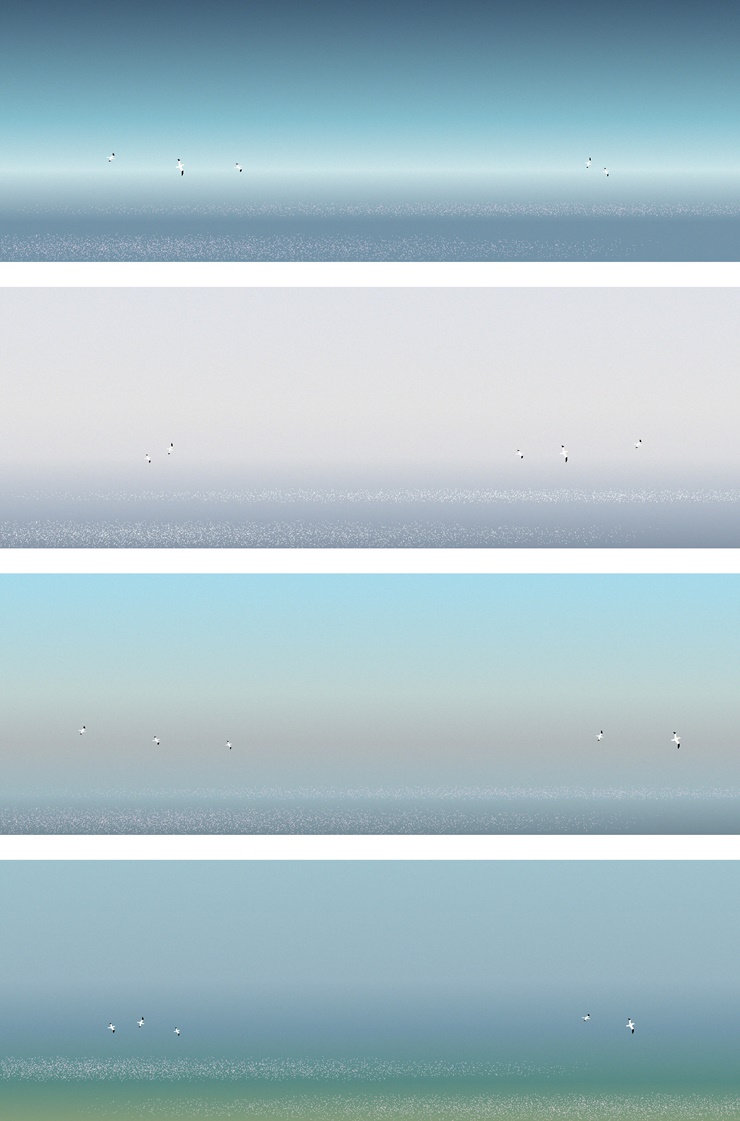
I can easily change the colours and place objects in different places. The folowing image are the same 'pattern' but using colours sampled from different photographs and altering the locations, widths, heights and angles of the gannets.
Fortran is a computing language that was widely used in the 1970s, mainly for scientific analyses. It is fairly basic and quite similar to the computing language called "Basic". It is not designed for dynamic or interactive computing that more modern languages are capable of. It is designed for 'numbers in - numbers out' and is very good at that. I use it here because I learnt it when I was younger and don't feel that any other language I know would be better for my purposes. I also feel that as many aspects of computing become history it's good to keep old crafts and traditions alive.